DSP, memory or other RTL blocks: how do they work?
From signed MACs and pipelines to memories, FIFOs, counters, and state machines: the circuit patterns behind useful RTL.
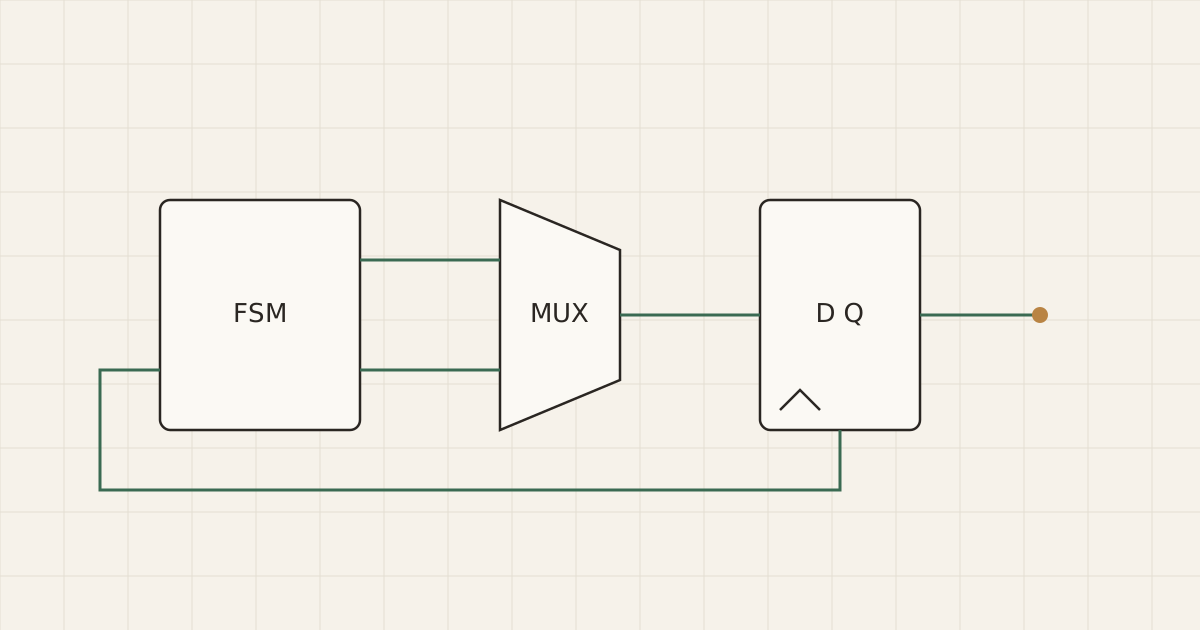
Names such as DSP, RAM, FIFO, and state machine describe useful hardware patterns, but they do not fully specify a circuit. A multiplier may be combinational or pipelined; a memory may have synchronous or asynchronous reads; a FIFO may expose its first word immediately or only after a read request. Understanding the underlying patterns helps you write better RTL requests and judge what an AI implementation actually builds.
Multipliers and multiply-accumulate datapaths
A multiplier forms the product of two operands. A multiply-accumulate datapath, or MAC, adds that product into an accumulator. With signed eight-bit operands, a full signed product fits in sixteen bits. Accumulating many products needs additional range or an explicit overflow policy. A wider accumulator delays overflow; it does not make overflow impossible for an unlimited stream.
module signed_mac (
  input wire clk,
  input wire rst_n,
  input wire clear,
  input wire enable,
  input wire signed [7:0] a, b,
  output reg signed [23:0] acc
);
  wire signed [15:0] product;
  assign product = a * b;
  always @(posedge clk) begin
    if (!rst_n || clear)
      acc <= 24'sd0;
    else if (enable)
      acc <= acc + {{8{product[15]}}, product};
  end
endmodule
This standalone Verilog example gives reset and clear priority over enable, sign-extends the product, and wraps on accumulator overflow. It is illustrative RTL, not an application-run functional verification result. It has no valid output or backpressure. Adding either requires a defined protocol, not just extra ports. The multiply and add are combinational before the accumulator register, which may be too much work for a particular clock target.
Pipelines trade latency for shorter stages
Registering an intermediate product splits a datapath across cycles. The accumulator must then consume the prior cycle’s product and the corresponding delayed enable. Forgetting that control delay can add stale data or drop the last sample. Similarly, a pipelined multiplier must carry valid information through the same number of stages as data. When stalls are possible, specify whether every stage freezes or whether the design uses independent elastic stages.
Pipelining can improve achievable frequency by shortening combinational paths, but it is not proof of timing closure. Register overhead, routing, fanout, target resources, and constraints matter. FPGA tools may map suitable arithmetic into dedicated DSP resources; ASIC tools may use a library-specific implementation. HDL Arena’s generic Yosys flow does not establish DSP inference, device utilization, or sign-off timing.
Fixed-point numbers need a scale
A signed vector stores an integer bit pattern. Fixed-point interpretation assigns a scale to that integer. If two signed sixteen-bit inputs each represent an integer divided by 256, their full product represents an integer divided by 65536. To return to the original scale, the design must deliberately shift and narrow, with a specified rounding and overflow policy. Arithmetic right shift preserves sign for a signed operand, but simply discarding fractional bits is not the same as rounding to nearest.
Document representable minimum and maximum values, intermediate widths, and whether overflow wraps or saturates. Saturation requires comparison and selection logic; it does not happen because a port is called “audio.” Test negative values, values near zero, maximum magnitudes, and the most-negative two’s-complement input. Those cases often reveal a signedness or width error that positive examples miss.
RAM and ROM are interfaces as well as storage
RAM stores writable values; ROM represents fixed contents. The same array declaration can lead to different synthesized structures depending on how it is accessed. Synchronous reads, asynchronous reads, number of ports, reset strategy, and read-during-write behavior all influence inference. A large reset loop over every memory element may prevent mapping to a compact memory resource on a particular target.
module small_ram (
  input wire clk,
  input wire we,
  input wire [3:0] addr,
  input wire [7:0] wdata,
  output reg [7:0] rdata
);
  reg [7:0] mem [0:15];
  always @(posedge clk) begin
    if (we) mem[addr] <= wdata;
    rdata <= mem[addr];
  end
endmodule
This example describes a registered read and a same-address write. Under nonblocking simulation semantics, rdata receives the old stored value on a write edge. Memory and output are uninitialized until established by writes and reads. Whether a target memory primitive supports that behavior must be checked in the target toolchain. The example is not a promise of block-RAM mapping. A ROM can instead use a self-contained case statement when appropriate; external memory-file loading is unsupported by the arena checker.
FIFOs, counters, and finite-state machines
A FIFO combines storage, read/write positions, occupancy tracking, and transaction rules. Pointer width depends on depth; non-power-of-two depths require explicit wrap handling. Full and empty flags must match the chosen acceptance rules, including simultaneous push and pop. A dual-clock FIFO additionally requires a clock-domain-crossing design, commonly involving synchronized Gray-coded pointers; a single-clock FIFO cannot be made asynchronous by renaming one port.
Counters track quantities or schedule events. Specify wraparound, saturation, enable, load, and reset priorities. A terminal-count pulse can be combinational or registered, which changes its observable timing. Finite-state machines organize control into states and transitions. Give combinational outputs default values, define recovery from illegal states, and distinguish Moore-style state-dependent outputs from Mealy-style outputs that also depend on current inputs.
Practical review checklist
- Describe each block’s transaction and cycle behavior before asking for implementation.
- Trace data and control together through pipelines, reset, and boundary conditions.
- Check widths, signedness, storage initialization, and simultaneous operations explicitly.
- Treat compilation and generic synthesis as limited evidence. Verify functionality and target DSP/RAM mapping in your own flow; a user preference or AI score establishes neither.