Why use HDL Arena instead of a generic AI chat tool?
Blind RTL comparison, practical engineering review, and approved learning workflows—plus the data-handling and verification limits to understand first.
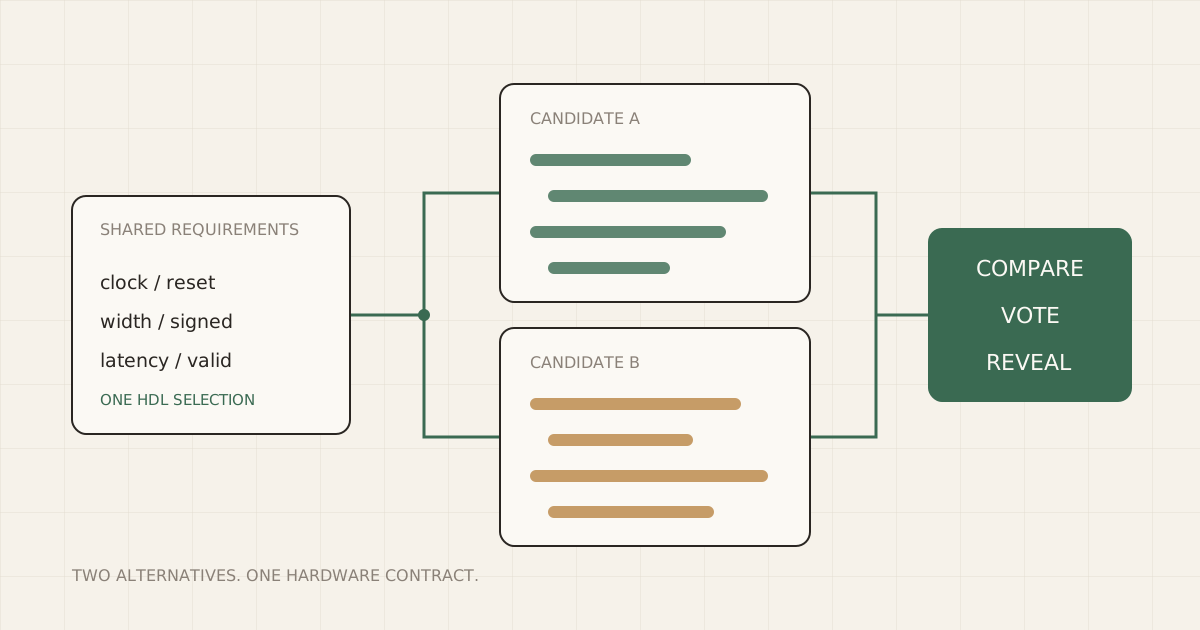
A generic AI chat tool can explain Verilog syntax, suggest a state machine, or help you think through a datapath. HDL Arena is useful when your next question is different: how do two AI implementations handle the same hardware contract, and which would you rather investigate? Its advantage is a specialized comparison workflow, not a promise that generated RTL is correct, that your employer approves it, or that sensitive designs stay private.
When generic AI tools are blocked at work
Some organizations restrict access to tools such as ChatGPT and Claude. The reasons can include data-handling requirements, procurement rules, or a policy that allows only selected services. HDL Arena can be a specialized alternative.
For an approved learning exercise, a synthetic eight-bit counter is a useful starting point. Specify a synchronous active-low reset, an enable input, and modulo-256 wraparound, then compare how two implementations express those rules. You can explore a real hardware concept without copying an internal register map or customer specification.
Treat hardware IP as sensitive—including here
A short prompt can disclose valuable hardware IP even without a full source file. Interface widths, proprietary packet fields, state transitions, performance targets, and comments about an unreleased architecture may reveal more than expected. Replacing a company name does not necessarily sanitize a design. Placing proprietary specifications or RTL into any externally hosted AI service requires a deliberate data-handling decision.
Consumer chat products, API services, and enterprise agreements can have different rules for training, retention, and access. It would be wrong to assume that OpenAI or Anthropic universally train on everything submitted, or that using their services inevitably causes a leak. It would also be wrong to assume that every account or API route has the protections of a particular enterprise contract. Review the applicable terms for the actual service and arrangement before submitting sensitive material.
Compare alternatives instead of accepting the first answer
In a chat session, a plausible first response can become the design you keep refining simply because it arrived first. HDL Arena makes alternatives part of the starting point: you supply shared requirements and choose one HDL language for both candidates. Two distinct models are randomly matched and generate independently. The comparison is between AI implementations of the same task—not between Verilog and VHDL versions with different language assumptions.
Read the anonymous candidates before voting. In the normal battle presentation, model identities, AI reviews and scores, and tool reports are withheld until your vote. Once generation and AI review complete, you can choose a candidate, a tie, or neither. Voting reveals the model identities and available reports. This gives you a chance to judge the source before a familiar model name or a reassuring score influences your preference.
Make the comparison concrete. For a signed multiplier with two eight-bit inputs, a sixteen-bit product, and one registered output stage, check whether each candidate actually declares signed operands and preserves the full product. Trace a negative input and the most-negative representable value. Then follow the valid signal: does it identify the matching product after the requested clock edge, or is it one cycle early? A polished explanation cannot compensate for a misaligned interface.
- Reset handling: is reset synchronous or asynchronous as requested, is its polarity correct, and are output data and valid state reset consistently?
- Signed arithmetic and widths: are sign extension, intermediate widths, truncation, overflow, and any saturation or rounding rules explicit?
- Latency and stalls: when is an input accepted, when does its result become valid, and what happens under backpressure or a disabled clocked update?
- Corner cases: for a FIFO, inspect simultaneous read/write at empty and full; for a counter, inspect wraparound, reset priority, and enable-low behavior.
Separate tool checks add another kind of evidence. The current checking flow compiles supported Verilog and a subset of SystemVerilog with Icarus, then runs generic Yosys synthesis after compilation passes. VHDL generation is available but is not checked by that toolchain. Unsupported constructs, resource limits, and unavailable checks must be distinguished from ordinary tool failures. Reports become visible after voting when available; they are not a prerequisite for your preference to be meaningful.
Comparison can expose weaknesses and help you select a candidate worth further work. It does not always produce the best implementation, and both candidates can be wrong in the same way. Compilation and generic synthesis are not functional verification. Neither are AI review scores or preference votes. A syntactically valid FIFO can still drop a transaction, and a smaller synthesized circuit can simply omit required behavior. Use your own simulation, assertions or formal checks, target synthesis, and timing analysis before relying on the RTL.
Keep working when internal AI budgets run out
An exhausted internal AI quota can interrupt a useful working session. If your organization permits it, an external workflow for suitable non-confidential work can offer another option: compare two ways to pipeline a synthetic multiply-accumulate unit, or study reset priorities in a public teaching example. The value is continuing an ongoing exercise
HDL Arena has its own account requirements, plan entitlements, capacity, and usage constraints. Starting battles requires an account and available entitlement; rate and concurrency limits still apply. Consult the current Pricing page and your account for applicable plan details. Provider failures or service capacity can also prevent a battle from completing.
A practical checklist before your first comparison
- Write one hardware contract: HDL language, ports, widths, signedness, reset, latency, handshake behavior, and corner cases.
- Check your account and current plan constraints. Allow for rate limits, capacity limits, and failed requests.
- Compare the anonymous source, vote honestly—including tie or neither—then inspect the revealed reviews and available checks. Verify any candidate independently before use.
If that checklist fits your situation, run a blind battle using the invitation below. Start with a small, non-confidential RTL task whose behavior you can reason about cycle by cycle. HDL Arena gives you two alternatives and a structured reason to inspect them; your engineering judgment and verification flow decide what deserves to go further.